
How to say an informal hi in Italian
Just like in English, Italian has several informal ways to say hi. The most common Italian greeting is Ciao (pronounced CHOW). Ciao is a simple, snappy way of saying hello and goodbye in Italian. It comes from the Venetian word sciavo—literally meaning servant or slave. It’s the modern Italian version of signing off ‘your humble servant’.
It’s common to pair Ciao with other words to make a whole greeting. For example, Ciao, come va? is a slightly informal way of saying ‘Hello/Hi, how’s it going?’ to someone you know. Ciao, come stai? is another informal way to say “Hi, how are you?”.
Ciao bella/bello or Ciao cara/caro are terms of endearment for greeting a loved one.
You can also say Salve, which is in between formal and informal in Italian. It’s a good choice if you’re unsure about the setting or ‘when in Rome’—that’s where it originates. This comes from the Latin salvere, meaning to be well or be in good health (also the root of the English ‘salutation’).
Ehi is the Italian adoption of the English word ‘hey’. You may use this with friends if you’re trying to catch their attention from down the street, but keep in mind that it can also express annoyance depending on the context.
How to say a formal hello in Italian
If you’re meeting someone for the first time or greeting an elder, a more senior colleague, or someone working in a restaurant or hotel, you’ll want to stick with formal greetings.
The most common way to say hello in a formal context is Buongiorno, which means good day. Another form is Buondì, though it’s much less common. When you walk into a shop, an employee may greet you with Benvenuto, meaning welcome.
It’s also polite to greet someone as Signore (Sir/Mr.) or Signora (Ms./Madam) when addressing someone. For example, Buongiorno, Signora Ferrari (Good morning, Ms. Ferrari), or Mi scusi, Signore (Excuse me, Sir).
When greeting someone formally, it’s important to use the formal pronoun form Lei instead of tu (you informal) to show respect. For instance, you’ll say Come sta? instead of Come stai? for ‘How are you?’. For someone you’ve already met, you can say Felice di vederti (nice to see you).
Italian greetings by time of day
While Buongiorno is the most common formal greeting, it’s only appropriate at certain times of day. The timing of the switch can vary by region: Some areas start using Buonasera after lunch, while others won’t until 4 or 5 pm.
- Buongiorno is used for mornings through the afternoon
- Buon pomeriggio means good afternoon, but it’s rarely used
- Buonasera means good afternoon and good evening. Use Buonasera to greet someone even if it’s late and dark outside. Buonanotte is only used to say goodnight (as in goodbye).
You’ll sometimes see these time-of-day greetings written as one word (Buongiorno) or two (Buon giorno). Both are accepted and correct, so don’t worry about how to write it!
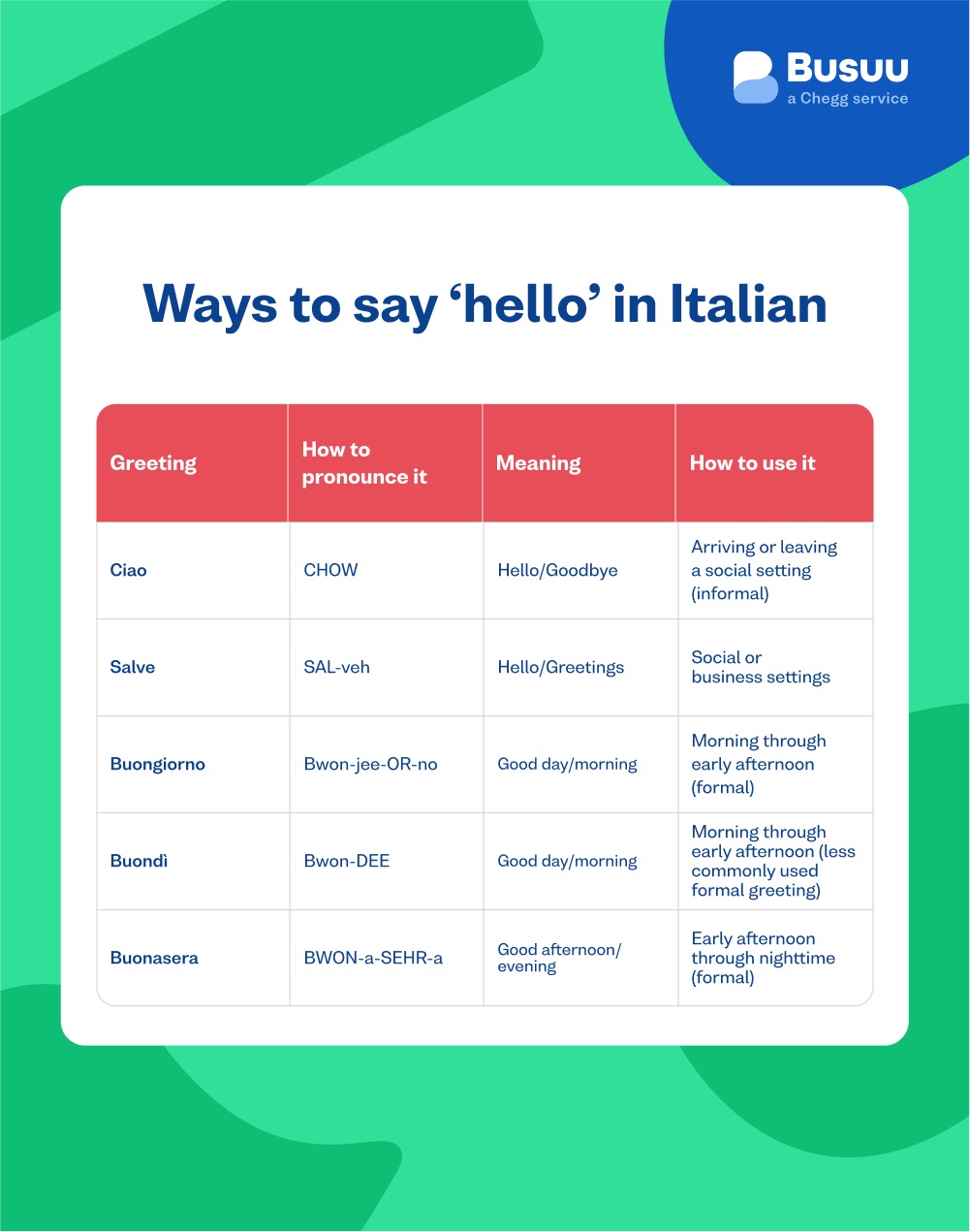
| Greeting | How to pronounce it | Meaning | How to use it |
|---|---|---|---|
| Ciao | CHOW | Hello/Goodbye | Arriving or leaving a social setting, informal |
| Salve | SAL-veh | Hello/Greetings | Social or business settings |
| Buongiorno | Bwon-jee-OR-no | Good day/morning | Formal greeting, morning through early afternoon |
| Buondì | Bwon-DEE | Good day/morning | Less commonly used formal greeting, morning through early afternoon |
| Buonasera | BWON-a-SEHR-a | Good afternoon/evening | Formal greeting, early afternoon through nighttime |
| Buon pomeriggio | BWON POHM-eh-ree-jo | Good afternoon | Less commonly used formal greeting, afternoon |
| Piacere/Piacere di conoscerti (informal)/Piacere di conoscerLa (formal) | PI-a-CHER-eh dee kon-OH-sher-tee | Nice to meet you | Meeting someone new, formal or informal |
| Lieto di conoscerti (informal)/Lieto di conoscerLa (formal) | lee-EH-toh dee kon-OH-sher-tee | Nice to meet you | Meeting someone new, formal or informal |
| Pronto? | PRON-toh | Hello (literally ‘ready’) | When answering the phone |
| Felice di vederti | feh-LEE-cheh dee veh-DEHR-tee | Nice to see you | Greeting someone you’ve already met |
| Ehi | EH-ee | Hey | Catching someone’s attention that you know or expressing surprise |
| Benvenuto | BEHN-vehn-OO-toh | Welcome | Welcoming a guest |
| Mi chiamo… | MEE kee-AM-oh | My name is… | Meeting someone new |
| Egregio | EH-GRE-jee-OH | Dear… | Opening greeting for a letter or email, formal |
| Mi scusi | MEE SKOO-zee | Excuse me | A polite way to get someone’s attention |
| Ciao bella/bello | CHOW BEHL-la/BEHL-loh | Hello beautiful | Platonic greeting of affection |
| Ciao cara/caro | CHOW KAHR-ah/ KAHR-oh | Hello dear | Platonic or romantic greeting of affection |
| Come va? | KOM-eh VAH? | How’s it going? | Informal with friends |
| Come sta? | KOM-eh STAH? | How are you? | Formal with bosses, professors, strangers |
| Come stai? | KOM-eh STAH-ee? | How are you? | Informal with friends |

